
Everyone sees problems in the world, but true visionaries have the drive and the passion to engage everyone around them to help solve them. Perhaps you are one of those people who have a unique solution to solving a problem or filling a need and the drive and ambition to accomplish it.
If the problem you are trying to solve or the need you are addressing isn’t a quick fix but instead long range, ongoing and/or escalating, you might consider forming your own nonprofit.
In this post, we’ll review frequently asked questions about starting a nonprofit and nine key steps to get your own organization up and running. Here’s what to expect:
Starting a nonprofit: FAQs
What is a nonprofit?
A nonprofit is a type of charitable organization created to improve society in some way. Nonprofits are legally defined by the IRS as “Organizations organized and operated exclusively for religious, charitable, scientific, testing for public safety, literary, educational, or other specified purposes and that meet certain other requirements are tax-exempt under Internal Revenue Code Section 501(c)(3).”
Why start a nonprofit (and not a for-profit)?
To receive and maintain tax-exempt status, the majority of a nonprofit’s income must come through public donations from individuals, corporations, and/or grants. Nonprofit organizations exist to serve the public, not to benefit the private interests of a single person, whether staff or board members.
Nonprofits offer free or low-cost programs and services to the public and rely on donations to do so. However, if your main goal is to make money and you have a successful revenue model, you would be wise to consider starting a for-profit.
How can I tell if my nonprofit will succeed?
All businesses need four things to survive: a brilliant idea, a great business plan, top-notch leadership and money.
For a nonprofit, initial success is determined by how exactly how brilliant the idea (also known as the “mission”) is.
Here’s how to test your idea out and gain initial feedback:
- Go to any networking event to test your idea with professionals you don’t know (no polling friends, family or co-workers!)
- When people ask you what you do, tell them you are the Executive Director of an organization that [insert your mission here.]
- How do they respond?
Good signs
If you get any responses like the ones below, you’re on the right track:
- “I wish that had been around when I was a kid!”
- “Wow, can I get involved or volunteer?”
- “That is so needed, thank you for doing that!”
- “I think I can introduce you to people who can help you.”
Bad signs
Go back to the drawing board if people reply by asking:
- “Doesn’t [insert competitor name here] already do that?”
- “Why is that needed?”
- “Wait, I don’t understand, can you repeat what you do?”
Can I start a nonprofit from nothing?
Sure! Most nonprofits begin from very humble origins.
The most important qualities to bring to the table are a clear mission and vision, passion for your cause and the dedication needed to bring your vision to life.
The tips in this guide will help you get your organization up and running, even if you’re starting from nothing.
How quickly can I start a nonprofit?
Starting a nonprofit doesn’t happen overnight.
The timeline generally looks like this:
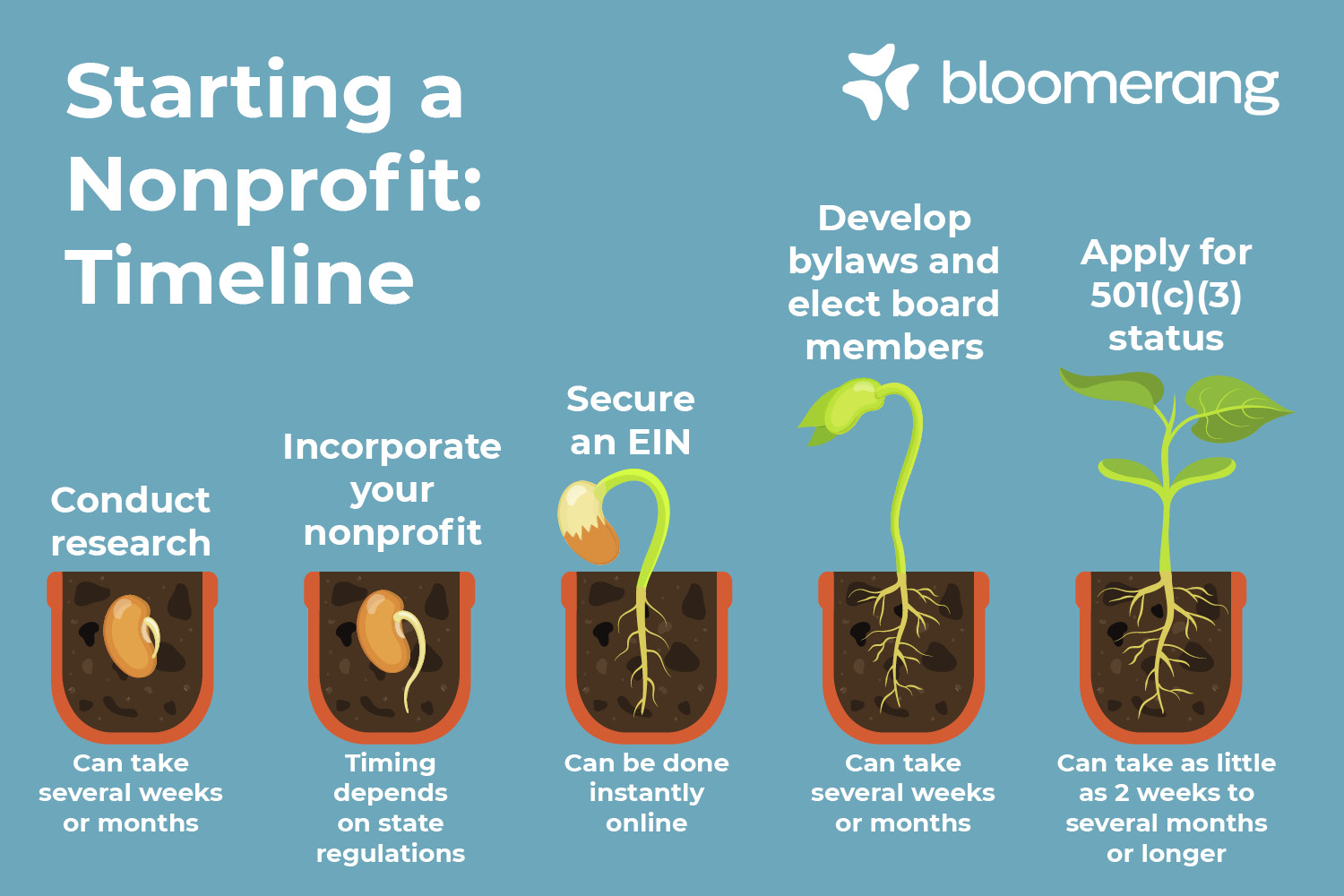
- Conduct initial research: Study similar nonprofits, their programs, successes or failures, funding and how you are similar or different. Are people excited when they hear about your cause? Do you have the financial resources to fund it? If not, how will you get the funds? Who will be on your board? Do you have the time and energy to run it? Do you have enough board members and volunteers to do the work? Is your idea an unmet need? Who is your competition and how are you different from them?
- Incorporate your nonprofit in your state: The timing for this step depends on your state’s regulations; it can take a few days or several weeks.
- Secure an Employer Identification Number (EIN): This can be done instantly online.
- Develop your bylaws and elect a board of directors: This can take several weeks or months.
- Apply for 501(c)(3) status through the IRS: Depending on the complexity of your nonprofit this step can take as little as 2 weeks or as long as several months or even a year. Your costs could be anywhere from $275 to $2,500, not including legal fees. Applying is not a guarantee of tax exemption, as applications can be denied.
Is there any way to get an “umbrella” fiscal sponsor to give me tax-exempt status?
Yes! Many community foundations are willing to give umbrella nonprofit status to nonprofits who may be just starting out. Additionally, individuals seeking tax-exempt status for a short-term charitable project with no need to formalize as their own nonprofit organization may seek out an existing nonprofit with a complimentary mission to be the project’s fiscal sponsor.
Can a nonprofit founder receive a salary?
Yes, you can receive a salary for your nonprofit work. However, the IRS dictates that your salary must be “reasonable” for the type of work you’re doing — “the value that would ordinarily be paid for like services by like enterprises under like circumstances.”
11 questions to ask yourself before starting a nonprofit
- Have you identified a clear need in your community that isn’t being addressed by other organizations?
- How will you distinguish your nonprofit from similar organizations?
- Can you think of a group of people who could be involved in running your nonprofit? Board members, volunteers, potential staff members, etc.
- Where will you seek initial funding?
- Do you have the time and dedication to get the organization up and running?
- Do people in your community seem willing to support your new nonprofit?
- How will you measure success for your nonprofit?
- What potential external threats and challenges could your organization face?
- How will you manage setbacks or obstacles while starting your organization?
- Are there other organizations, such as businesses or foundations, that you can potentially partner with in your community?
- Is your nonprofit idea scalable? Can you grow your nonprofit sustainably over time?
How to start a nonprofit in 9 easy steps
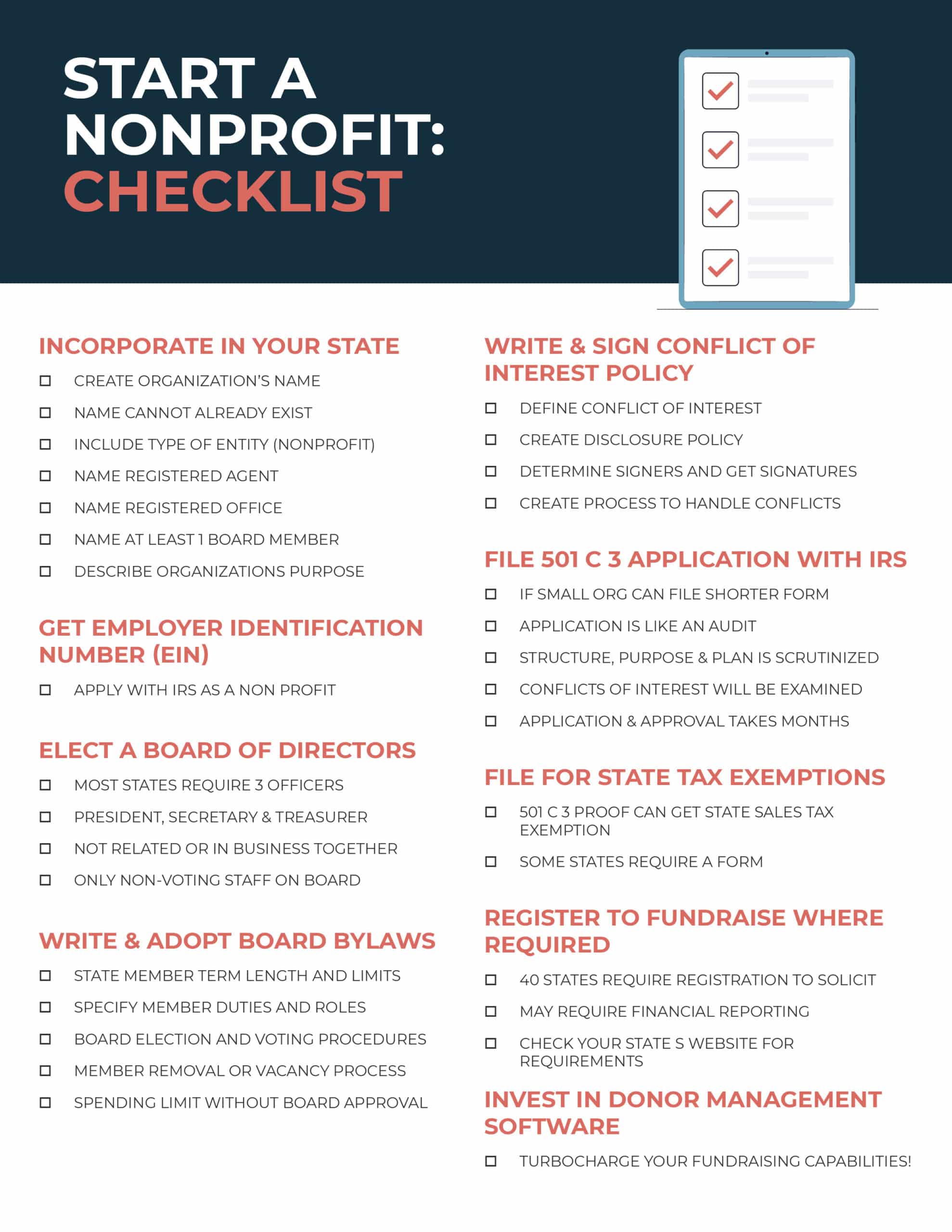
1. Incorporate your nonprofit.
Filing your articles of incorporation allows you to be recognized as a business entity in your state. It does not give you nonprofit status, however. It serves to remove you as the founder from being personally liable. The requirements and cost of incorporating vary from state to state. You should be able to find information on how to file your articles of incorporation on your secretary of state’s website. Following the directions at the site, you may be able to submit your application online.
2. Secure an Employer Identification Number (EIN)
Every organization must have an employer identification number (EIN), even if it will not have employees. The EIN is a unique number that identifies the organization to the Internal Revenue Service. You can apply for an EIN online, by mail, or by fax.
3. Elect a board of directors.
You cannot submit your 501(c)(3) application to the IRS for your nonprofit status without listing your board officers with name, title and contact information. Most states require a minimum of three individuals on the board: a President, Secretary and Treasurer. Ideally, these individuals are not blood related or in business together. Public charities must have a board with a majority of unrelated members. Paid staff members are not allowed to be on the board unless they recuse themselves from voting.
4. Create your bylaws.
Your 501(c)(3) application to the IRS must include bylaws. Bylaws are the main governing document of your nonprofit and will act as a guide and decision-making tool for the board of directors.
Here are some tips to develop your bylaws:
- State your organization’s name and purpose
- Establish guidelines for your board’s purpose, powers, tenure, size, election processes, vacancies, resignations, and removal process
- Create a structure for electing board officers
- Establish policies for board meetings, such as the frequency and meeting format
- Define your fiscal year
- Create policies for developing committees
Bylaws serve as a safeguard and supplement those already required by the state and IRS.
5. Develop a conflict of interest policy
After you create your bylaws, develop a written conflict of interest policy. Check if your state of incorporation has specific requirements for what must be included in the policy. A strong conflict of interest policy will help ensure your organization is well governed and protect your leadership.
Elements typically included in a conflict of interest policy include:
- A definition of what constitutes a conflict of interest
- A policy for disclosing conflicts of interest
- Information about who the policy applies to
- Uniform procedures for handling conflicts of interest
Review and approve all these documents at your first board meeting. In addition, use the time to elect officers and establish roles.
6. Apply for federal tax-exempt status.
Once you have completed steps 1-5, you are ready to apply for 501(c)(3) tax-exempt status.
The most common type of nonprofit organization is the 501(c)(3), which covers all charitable, religious, scientific, and literary organizations. You can see the full list of the 29 different types of charity organizations here.
If you are a small organization with gross income under $50,000 for the last 3 years and expect to have gross income under $50,000 for the next 3 years, you can file a shorter Form 1023-EZ which can be approved in as little as 4 weeks.
7. File for state tax exemptions.
If you received your 501(c)(3) designation from the IRS, you can use that designation to avoid paying sales tax if your organization operates in a state with sales tax. In some states, merely showing your IRS determination letter or your tax-id number is enough, whereas in others, you may be required to complete a form.
8. Register to fundraise where required.
Currently, 40 states require nonprofits to register with their state before soliciting contributions from residents. In addition, these charities may be required to file periodic financial reports. Visit your state website to find information on your state registration requirements.
9. Invest in donor management software.
After you’ve satisfied all of your legal requirements and started fundraising, we recommend investing in donor management software. Donor management software will help you keep all your donor information organized in one centralized location. Top software solutions like business offer features such as donor profiles, constituent timelines, marketing and engagement tools, reporting and analytics features, wealth screening tools, and integrations with other top nonprofit software platforms.
The goal of this software is to help you centralize all of your data into one place, track your nonprofit’s financial success, manage donor relationships, and more.
Maintain compliance
Your 501(c)(3) status, once granted, never needs to be renewed. However, you need to fulfill the following to maintain your status:
- Follow your by-laws
- Maintain detailed financial records and minutes of all board meetings
- File your 990 each year with the IRS. You can think of a 990 as an informational tax form. It is a publicly available document that details your organization’s activities, finances, board members, and lead staff.
- File state tax forms annually
Most states require nonprofits to file paperwork to fundraise in their state. States that do not require this paperwork may require you to file for corporate tax exemption.
Now that you are officially a nonprofit and have purchased your fundraising and donor management solution, it’s time to fundraise!
At business, we’ve crafted a treasure trove of fundraising resources waiting for you, including fundraising guides and templates, webinars, how-to articles and even an expert on standby just for your questions!
Getting your 501(c)(3) status approved is a bit like taking home a new baby, puppy, or getting the keys to your first home. There’s a ton of excitement, but it’s also where the real work begins. business is here to support you at every stage!
Disclaimer
Because state laws vary and laws can always change, we encourage you to seek out local expertise (either an attorney, accountant, or someone familiar with the laws affecting how charitable organizations operate in your state) to ensure your new nonprofit complies with state, local, and federal law.